Showing posts with label cemeteries. Show all posts

Tuesday, October 12, 2010

Listen and Learn


"Do not pass by my epitaph, traveler.
 But having stopped, listen and learn, then go your way." -Roman Tombstone


I have always been fascinated by old graveyards, those rambling, untidy cities of the dead. Love and longing, loss and sweet remembrance all find expression there.

Our American children celebrate Halloween, All Hallow's Eve, by wearing costumes and harvesting bags of treats from friendly neighbors. This harmless fun stems from the ancient Celtic belief that
"the border between this world and the Otherworld became thin on Samhain, allowing spirits (both harmless and harmful) to pass through. The family's ancestors were honoured and invited home while harmful spirits were warded off. It is believed that the need to ward off harmful spirits led to the wearing of costumes and masks. Their purpose was to disguise oneself as a harmful spirit and thus avoid harm." -Wikipedia
The Catholic Church has recast this pagan tradition as two Autumn feast days, All Saints' Day (All Hallow's Day), November 1, and All Souls' Day, November 2, both intended to honor the Christian dead.

There are many stories to be told in cemeteries, and the cross-curricular possibilities are endless.

I've gathered a collection of links and resources in a cemeteries wiki that is available for use by any interested educator.

Suggestions range from mapping grave sites to analyzing tombstones; composing epitaphs to writing dramatic "tours;" preserving history to researching ancestors.

The Poets' Corner memorial plaque for T.S. Eliot reads, "The communication of the dead is tongued with fire beyond the language of the living."

Listen and learn.


Related posts:
Remembering
Truthville
The Brisbins of Saratoga County


"Requiescant in Pace 11/01/09" by dmcordell
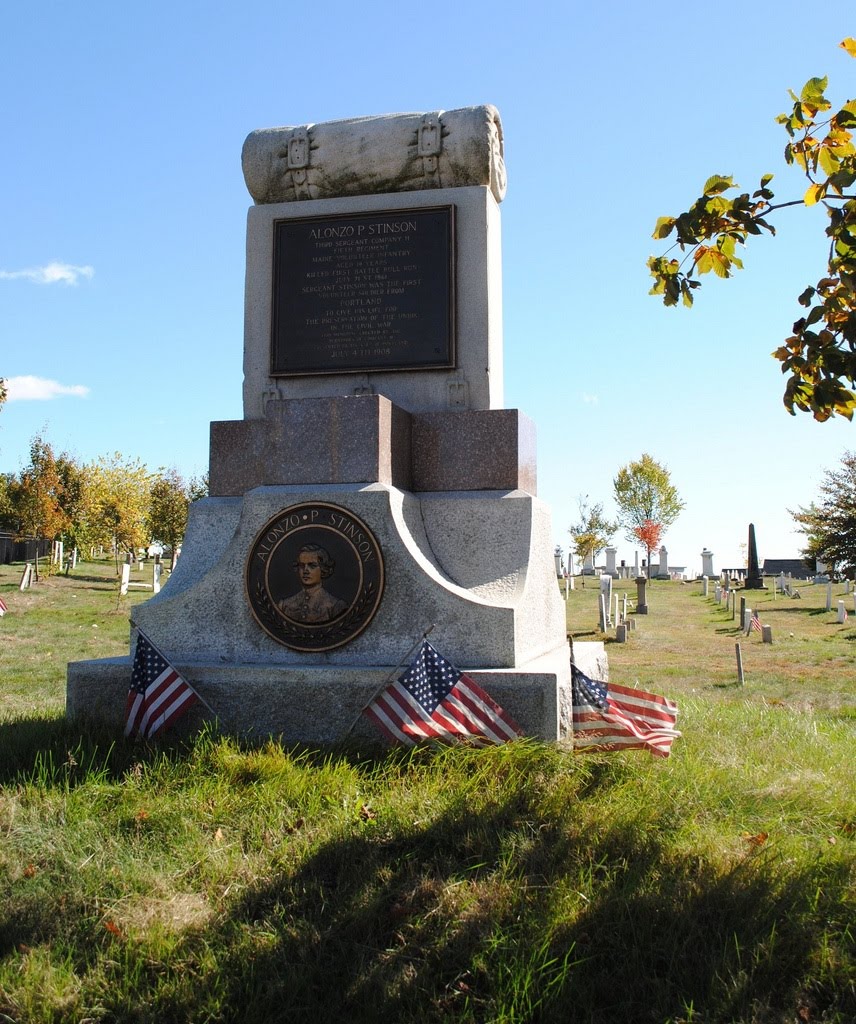
"Alonzo P. Stinson" by dmcordell

Monday, May 25, 2009

Remembering


Although it began as a day to remember those who died in the American Civil War, Memorial Day (once know as "Decoration Day") now honors all U.S. men and women who died while in the military service.

I thought this would be an appropriate time to visit one of our local cemeteries, where grave markers and flags indicate the final resting place of those who served in our armed forces.

Some of these men and women returned home to finish lives interrupted by war. They are recognized on Veterans Day.

Others died in faraway places, fighting for the country that they loved. These are the honorees on Memorial Day.


The peace of the morning was briefly disturbed by the sound of a parade on a neighboring street. There were to be patriotic songs played and heartfelt speeches given at a war memorial in the city park.


I preferred to linger a while with the dead.


"Blow out, you bugles, over the rich Dead!
There's none of these so lonely and poor of old,
But, dying, has made us rarer gifts than gold."
-Rupert Brooke


"We who are left how shall we look again
Happily on the sun or feel the rain
Without remembering how they who went
Ungrudgingly and spent
Their lives for us loved, too, the sun and rain?"
-Wilfred Wilson Gibson


"United States Flag" by tomsaint11

Monday, October 6, 2008

The Brisbins of Saratoga County


On Saturday, my husband and I drove past a tiny, enclosed burial ground and stopped for a closer look. I took a few photos, then decided to try a quick Google search of the family name, Brisbin, later that evening.


The wealth of information that I discovered was amazing:
  • New York Gravestones provided an easy-to-read "translation" of inscriptions on the worn headstones.
  • The Town of Northumberland traced the family's history back to 1765, when 18-year-old James Brisbin arrived in upstate New York from his native Scotland. "He settled 1 1/2 miles westerly of Fort Miller, towards Bacon Hill a hamlet in Northumberland that became the hub of activity with the Hudson River nearby."

  • By 1789, a mature (and, presumably prosperous) Brisbin was elected an elder of the Reformed (Dutch) Church of Saratoga, according to the 1878 History of Saratoga County, New York, by Nathaniel Bartlett Sylvester.

  • A descendant of the Brisbins noted on her genealogy site that the family name probably "stems from the Scottish name, Brisbane" and adds,
    "There is speculation, as yet unconfirmed, that the Brisbins immigrating to New York were soldiers during the French and Indian war, which ended in 1763. They liked what they saw in the territory and decided to return with their families. Since our family appears on the records of Saratoga Co., NY for the first time about 1765, this seems to add credence to this theory. There is also some speculation that the Brisbin soldiers may have been part of Abercrombie's troop in the French and Indian War, which were known to have been in Saratoga County. From this point on, there are documented records on the Brisbin family, both in America and in Canada."
  • "The Campaign of Lieut. Gen. John Burgoyne and The Expedition of Lieut. Col. Barry St. Leger," by William L. Stone (Albany, NY, Joel Munsell, 1877) mentions the Brisbin property during the time of the American Revolution.
    "As a specimen, the farm of James Brisbin had sufficient wheat and cattle to have paid the purchase price, but it was all taken and consumed by Burgoyne's army without compensation, notwithstanding the fair promises made in his proclamation of July 10, before stated. We should except a single cow, which escaped from her captors, returned home and was afterwards secreted and saved. After the surrender, the farmers gradually returned to their rural homes, erected new log houses, and began again to till the soil. But little progress, however, was made, until the close of the war, as this valley lay in the track of the Indians and Tories, who had fled to Canada, and made repeated raids into this county."
  • A similar genealogy page, that of the McGregors, mentions two sons of James Brisbin.
    "The first settlement of what is now the town of Wilton, but then and long before known as Palmertown, was begun by two brothers, William and Samuel Brisbin, as early as the year 1764. These two brothers were the sons by his first wife of James Brisbin, who came over from the north of Ireland, and became the first settler of what is now the town of Northumberland, in the year 1765. The two brothers, William and Samuel Brisbin, made their first attempt at settlement on the south branch of the Snoek Kill, in what afterwards became the Laing neighborhood. One and perhaps both of them had been soldiers under Abercrombie and Amherst in the last French war, and the year after peace was concluded they began the early settlement of the old wilderness they had so often traversed while on the war-path. They made clearings, built a sawmill, and cut roads on to their lands. When the war of the Revolution came on they abandoned their little settlement."
    One of the McGregor daughters later married into the Brisbin family. [There were many "James Brisbins" in the family. The father of William and Samuel might be the father or uncle of the James Brisbin who died in 1835 and is buried in the family plot.]

  • Another local family was the Slocums. In "A Short History of the Slocums..." by Charles Elihu Slocum, we learn that Sarah Slocum married James Brisbin. These are the James, Jr. and his wife, Sally, who share a headstone and a final resting place. Other Slocums also intermarried with the Brisbins. When his father, Giles Slocum, died in 1814, James Slocum went to live with his maternal grandfather, James Brisbin, "near Schuylerville, Saratoga County, New York."


Every town and village has at least one cemetery within its boundaries. The educational possibilities are endless. Students might
  • research prominent local names
  • map an entire burying ground
  • undertake a cemetery restoration project under the guidance of adult professionals
  • place names copied from headstones on a timeline
  • write original stories or poems about the people buried in the cemetery
  • search for information about an individual, then present a scene from his/her life (in period garb)
  • recreate significant events from the history of their county or state, as seen through the eyes of actual residents
It is people that create history, and projects that emphasize human connections can be satisfying, enlightening...and fun!

Saturday, July 5, 2008

Truthville

My daughter and I set off on an impromptu adventure yesterday, a road trip through rural Washington County, NY.

The big white church caught our eye first.


Across the street was Bethany Cemetery, Truthville, NY.

My initial thought was to take a few pictures of some graves, presumably of veterans, which were decked out in patriotic colors for the Fourth of July. But it didn't take long for my interest to broaden.

The shared headstone of Cora and Harold Douglas celebrates their long life together: "Whither thou goest I will go". Little Tanya Susan Cain was only on this earth for two days; a tiny lamb graces her resting place.

The older stones bore their own truths. Most of the women were either "the daughter of" or "the wife of" someone, having surrendered a part of their identity to their male relatives.

Many females died in their late teens or early twenties. Did childbirth carry them off at so young an age?

What tragic chain of events claimed the life of Eliza Corbin "who was drowned at Whitehall Landing, July 26, 1825, aged 18 years & 8 months, leaving a sorrowful husband & many weeping friends."

Sally Baker's large stone is elaborately decorated. Does her anchor symbolize faith, or was her husband or a family member involved with ships or the Navy?

Jeremiah Brownell was born in 1731 or 1732. Did he bear arms in the French & Indian War, then pick up his musket again in middle age to join the Colonials in their fight for independence? Was he a Loyalist? Or did he arrive in upstate New York after the battles were done?

What manner of person was Chapin, whose irregular rock bears a single name, with no other information?


The little cemetery at Truthville reminded me of Spoon River Anthology. Edgar Lee Masters recreated an entire community by sharing narratives of the departed residents of a fictitious town.

We can only guess at "truths" of Truthville. These crumbling inscriptions give no sense of the fire and passion of the people who once bore these names. Perhaps that is exactly what they would have wished.


"Truthville" set on Flickr